
For many rights holders, Guatemala has traditionally raised questions when it comes to intellectual property enforcement. Trademarks may be registered, but doubts often remain about whether those rights translate into concrete action against counterfeit goods.
The official results from 2025 provide useful evidence that enforcement is not merely theoretical.
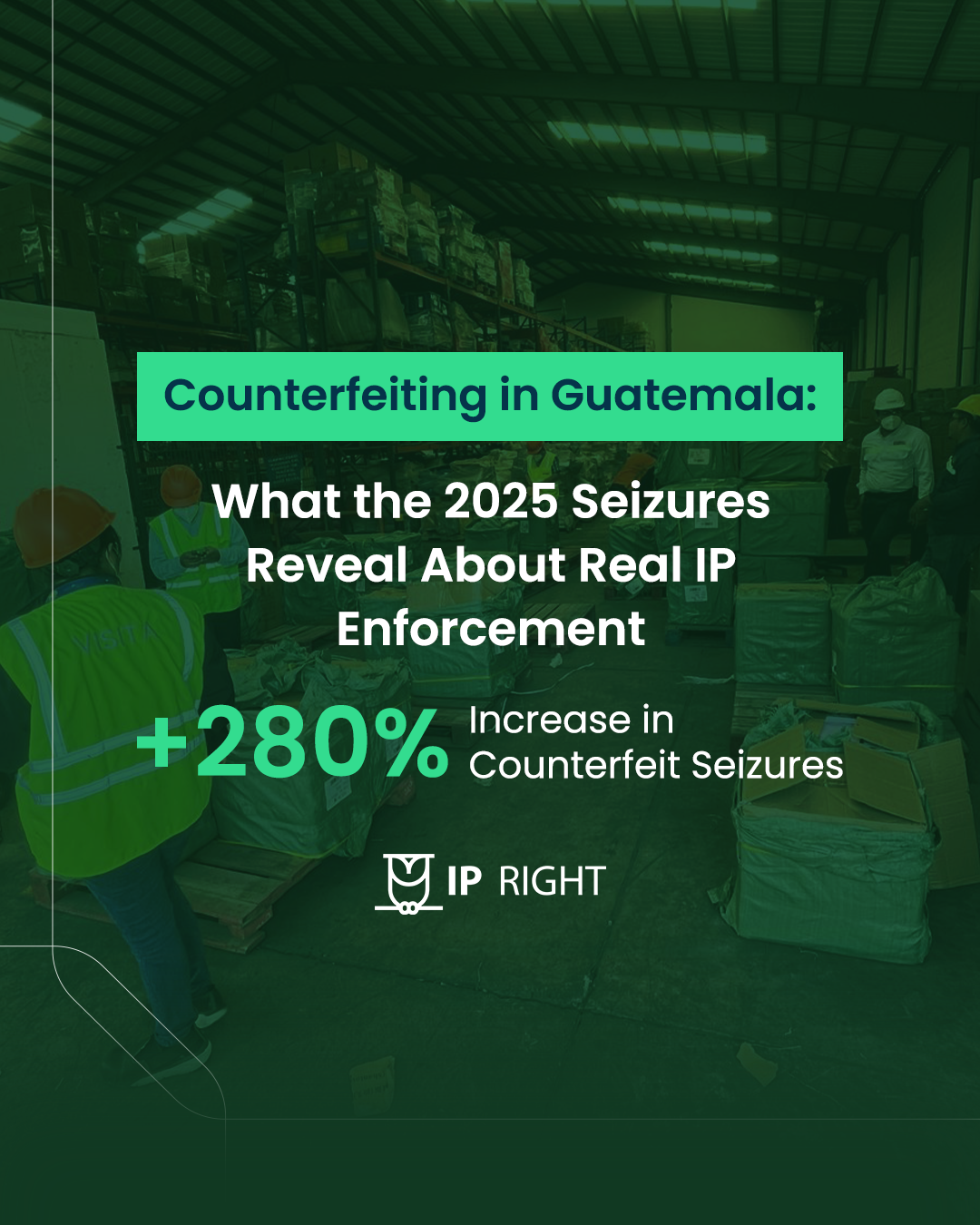
According to data released by Guatemalan authorities and reflected in national reporting, seizures of counterfeit merchandise increased by more than 280% during 2025. Beyond the headline figure, what truly matters for brand owners is what this increase represents: intellectual property law is being enforced when the right conditions are in place.
This article examines what those developments mean for you as a rights holder and why Guatemala is showing clearer signs of effective enforcement against counterfeiting.
The growth in counterfeit seizures during 2025 focused primarily on footwear, apparel, textiles, and other consumer goods, sectors that have long been exposed to trademark infringement and unauthorized distribution.
This increase is not explained solely by higher trade volumes. It reflects improvements in detection mechanisms, better risk profiling, and more active inter-agency coordination, particularly through bodies such as COINCON, with execution led by the SAT.
For rights holders, this translates into something tangible: counterfeit goods are being identified and intercepted at key entry points rather than circulating freely through the market.
If you manage trademarks in Guatemala or across Central America, the 2025 results have direct strategic implications. Guatemala plays an important role within regional distribution chains. When counterfeit products are stopped locally, their movement into neighboring markets is also limited.
This creates immediate value for brand owners: fewer counterfeit goods competing with legitimate products, reduced reputational exposure, and stronger protection of the commercial value associated with registered trademarks.
The data confirms that enforcement is not uniform for every brand, but it is effective for those that have structured their rights properly and taken active steps to protect them.
One critical point behind the 2025 results is that enforcement does not operate automatically. The most effective actions have occurred where rights holders:
When these elements are present, authorities have the tools needed to intervene decisively. Without them, even a more active enforcement system has limited reach.
From a local enforcement perspective, several practical developments became visible during 2025:
More targeted counterfeit detection
Authorities have focused more directly on trademark infringement cases rather than applying broad, non-specific controls.
Better use of brand information
Access to updated trademark data and recurring import patterns has enabled more accurate identification of counterfeit shipments.
Measurable economic impact
The fiscal value of seized counterfeit goods reached significant levels, translating into real market protection for rights holders rather than symbolic enforcement.
These developments do not eliminate all risk, but they demonstrate that enforcement mechanisms are functioning when rights holders are properly positioned.
For years, some brand owners avoided enforcement actions in Guatemala due to the assumption that results would be uncertain. The 2025 figures challenge that assumption.
Guatemala is not a risk-free jurisdiction, but it is a jurisdiction where IP enforcement can be effective and measurable when rights holders engage proactively. Ignoring these developments may leave brands unnecessarily exposed to counterfeit activity.
If you are assessing whether enforcement efforts in Guatemala are worthwhile, the 2025 data offers several practical conclusions:
The question is no longer whether IP law can be enforced, but whether your brand is positioned to take advantage of the enforcement capacity that already exists.
IP done right.